


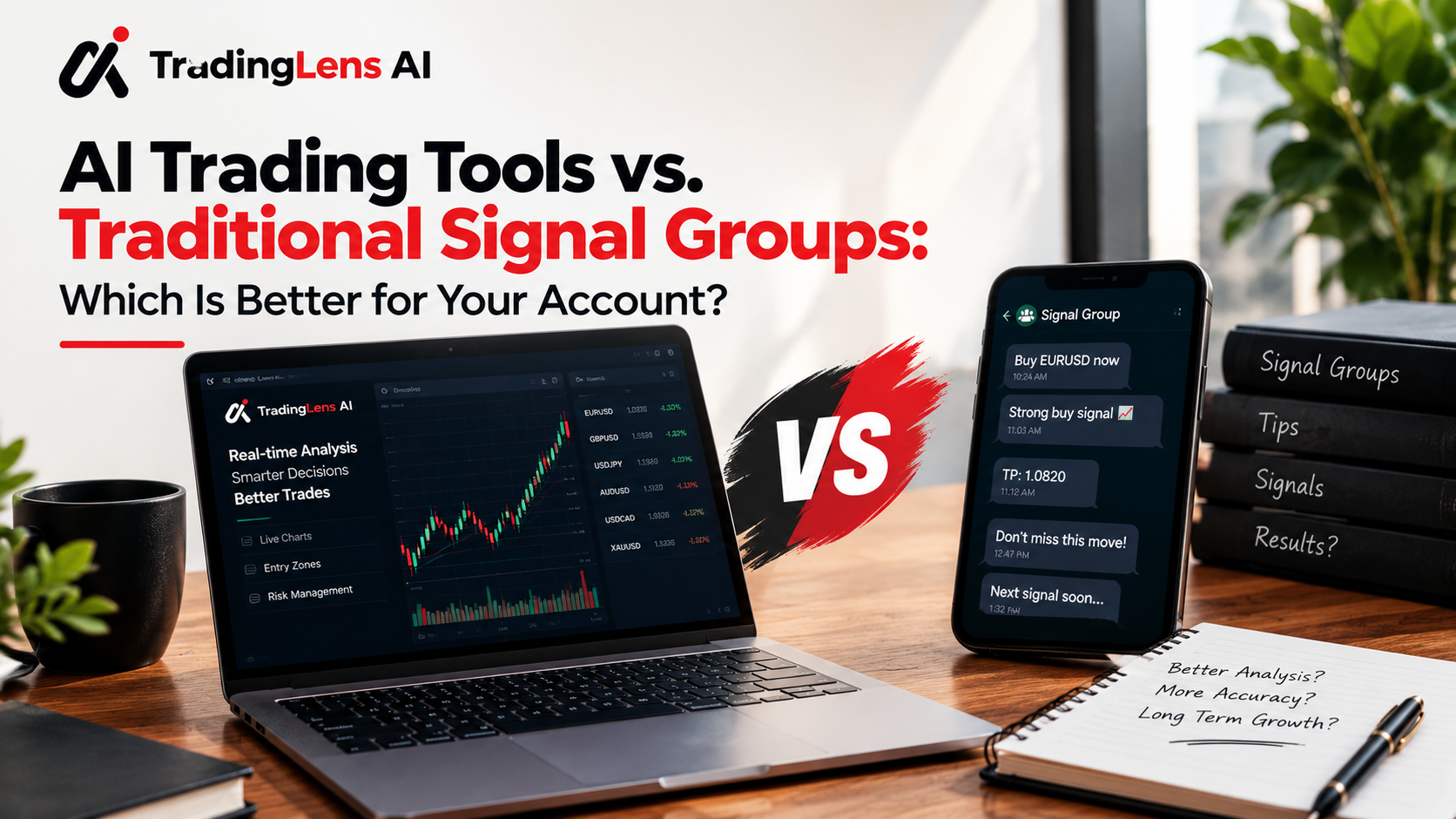
If you have spent any time in trading communities on Telegram or WhatsApp, you already know what a signal group looks like. Someone posts a trade direction, an entry price, a stop-loss, and a take-profit. You copy it into your broker platform. You wait. Sometimes it works. Sometimes it doesn’t. Either way, you have no idea why.
That right there is the core of the AI trading tools vs signal groups debate, and it is a debate worth having properly because the choice you make here has real consequences for how long you last in this market.
This is not about which one makes you money faster in the short term. It is about which one actually makes you a trader.
What Signal Groups Actually Are
A signal group is exactly what it sounds like. A provider, usually someone claiming trading expertise, sends alerts to a group of subscribers telling them when to buy or sell a particular asset. The message typically includes the pair or instrument, the direction, entry price, stop-loss level, and one or two take-profit targets.
Some groups charge monthly subscriptions. Others offer free signals and make money from broker referrals. A few are run by people who genuinely know what they are doing. Most are not.
The appeal is obvious. You do not need to learn anything. You do not need to analyze charts. You just follow the instruction and hope the trade works out. For someone who is new to trading and overwhelmed by the learning curve, that simplicity feels like a gift.
It is not a gift. It is a shortcut that costs you more than it saves, and the price is not always obvious until you have already paid it.
According to a review of signal group performance tracking published on Forex Peace Army, the majority of signal services that get independently verified show inconsistent results over a 12-month period, with win rates that frequently fail to account for realistic position sizing, slippage, or subscriber execution timing.
The 5 Core Problems With Signal Group Dependency
Problem 1: You are always one step behind
By the time a signal reaches your phone, the market has already moved. The provider entered at one price. You are entering seconds or minutes later, at a worse price, with a tighter effective stop-loss and a smaller actual reward. Even when the trade works, you get a smaller version of the result. When it does not work, your loss is exactly the same size as the provider’s.
Problem 2: You have no idea what to do when it goes wrong
This is the one that genuinely hurts people. The trade is open. Price is moving against you. Your stop-loss is 20 pips away and the market is getting close. Do you hold? Do you close early? Do you wait for an update from the group? You have no framework for making that call because you never understood the reasoning behind the setup in the first place.
Signal group problems compound here. The provider might not update the group until after the stop-loss has already been hit. Some providers do not post losing trades at all. You are making real financial decisions with incomplete information and zero personal understanding of the setup.
Problem 3: The results you see are not the results you get
Most signal providers post their winning trades with screenshots. Losses either disappear or get framed as “the market was manipulated” or “news event.” Even the providers who do post full records rarely account for the realistic execution spread that subscribers face. A signal that looks like a 1:3 risk-reward on the provider’s chart is often closer to 1:1.5 for the subscriber who entered three minutes later at a different price.
Problem 4: You cannot scale it
Once you start thinking seriously about trading as a skill you want to develop and a business you want to build, the signal group model hits a wall. You cannot grow as a trader because you are not trading. You are copying. There is no analysis, no pattern recognition developing, no understanding of market structure accumulating. Six months in, you know as little about reading a chart as you did on day one.
Problem 5: Dependency is the product
The best signal group businesses are not incentivized to make you better at trading. They are incentivized to keep you subscribed. If you learned to trade on your own, you would cancel the subscription. The model works precisely because it keeps you needing it. That is not a conspiracy theory. It is just how the incentive structure works, and recognizing it is important before you commit to paying for it month after month.
What AI Trading Analysis Does Differently
AI trading tools vs signal groups is a comparison that only makes sense once you understand what AI analysis actually does, because it is a fundamentally different thing.
An AI trading tool like TraderLens does not tell you what to do the way a signal provider does. It shows you what is happening in the market, why a particular setup is forming, and what the relevant levels, structure, and probabilities look like. Then you make the decision.
That distinction matters more than it sounds.
TradingLens AI analyzes live market data across forex pairs, stocks, indices, and crypto in real time, identifying confluence across price action, key levels, and market structure before surfacing a setup. When TraderLens flags a trade opportunity, it shows the entry zone, the stop-loss placement and the reasoning behind it, the take-profit target, and the market context that makes the setup valid. You see the chart. You see the structure. You understand what you are looking at.
That is what turns analysis into education over time. Every setup you review teaches you something about how the market behaves. Six months of using an AI trading tool builds pattern recognition that no signal group will ever give you.
The best trading signal vs AI comparison is this: one gives you a fish, the other teaches you to read the water.
For a full breakdown of what TraderLens specifically does and how the AI engine works, the TraderLens feature page covers it in detail.
Transparency: Who Is Accountable?
This question is more important than people give it credit for. When a signal group trade loses, who is responsible? The provider posts a brief message about “market conditions” and moves on to the next call. You absorb the loss. There is no accountability mechanism in the traditional signal group model because the provider has already been paid their subscription fee regardless of outcome.
With an AI trading tool, the accountability is different and more useful. The tool shows you the conditions under which a setup was identified. If the trade does not work, you can go back and understand what happened: whether the setup was valid and simply did not play out, whether a news event disrupted the technical picture, whether the stop-loss placement was too tight for the volatility at the time. That post-trade review is where a huge portion of learning actually happens.
One thing that consistently comes up in trading community discussions on communities like Trade2Win is the frustration traders feel after months in signal groups when they realize they cannot explain a single trade they have placed. They have a track record of results, wins and losses, but zero understanding of why any of it happened. That gap is the real cost of signal group dependency.
Building Your Own Edge vs. Following Someone Else’s
Here is the thing about trading edges: they are personal. What works for one trader does not automatically work for another, even if the setup is technically identical, because the execution, the sizing, the confidence in the trade, and the ability to manage it under pressure all depend on whether you understand what you are doing.
When you build your own edge through AI-assisted analysis and real-time market feedback, you develop something a signal group can never give you: conviction. Conviction is what lets you hold a trade to the take-profit instead of closing early out of fear. It is what lets you accept a loss without revenge trading because you know the setup was valid even though it did not work. It is what separates traders who compound their account from traders who cycle through the same lessons indefinitely.
AI vs manual trading signals is not really a technical debate. It is a question about what kind of trader you want to become. Signal groups produce followers. AI trading tools build analysts.
For a primer on what AI trading actually is and how it works at a foundational level, the AI trading for beginners post is a good starting point before going deeper into platform comparisons.
The Long-Term Cost of Each Approach
Let’s be honest about the numbers here, even roughly.
A typical signal group subscription runs anywhere from $30 to $150 per month. Over 12 months, that is $360 to $1,800 spent. At the end of that year, assuming the group is even legitimate, what do you have? A record of copied trades and no ability to generate your own analysis.
An AI trading platform may have a comparable or slightly higher entry cost, but what you accumulate over the same 12 months is entirely different. You have developing chart-reading skills, pattern recognition, an understanding of market structure, and a growing ability to identify setups independently. The tool compounds your capability, not just your exposure to trade calls.
The long-term cost of signal group dependency is not just financial. It is the opportunity cost of time spent not learning. Twelve months of serious, structured engagement with an AI trading tool is genuinely transformative for most traders. Twelve months of copying signals from a Telegram group leaves you exactly where you started, except lighter in the pocket.
If you want to see where TradingLens AI sits on pricing and what each plan includes relative to what you get, the pricing page lays it out clearly with no hidden structure.
A real observation from traders who have made this switch: the first few weeks with an AI tool feel harder than using a signal group, because now you are actually engaging with the market instead of just copying a call. That discomfort is exactly the point. It is the feeling of learning something real.
The traders who stick with it consistently report that within two to three months, they start trusting their own reads on the chart. They start disagreeing with signal calls they previously would have copied without question, and more often than not, they turn out to be right. That is the moment the shift becomes permanent.
AI trading tools vs signal groups is not a complicated question once you decide what you actually want from trading. If you want quick calls to copy, there are plenty of groups willing to take your subscription money. If you want to become someone who can actually read the market, understand what is happening, and make decisions you can defend, AI analysis is the only tool that gets you there.
FREQUENTLY ASKED QUESTIONS
Q: Are trading signal groups worth it?
Honestly, for most traders, no. Not as a long-term approach. Signal groups can feel useful in the short term because they remove the pressure of making your own decisions, but that is also their biggest problem. You are not learning anything. You are not building any skill. You are just outsourcing your decision-making to someone you have never met, whose actual track record you cannot verify, and who gets paid whether your trades win or lose. The traders who rely on signal groups for more than a few months tend to find themselves in the same place they started, but with a smaller account and a growing frustration they cannot quite explain. The dependency itself is the issue. A trading approach that only works when someone else is telling you what to do is not a trading approach at all.
Q: Can I use both AI tools and signal groups at the same time?
You can, but the honest answer is that using both creates a conflict that most people do not anticipate. When the AI analysis says one thing and the signal group says another, which one do you follow? If you follow the signal group out of habit or because the message came first, you are not really using the AI tool. If you follow the AI tool, you stop needing the signal group fairly quickly. What tends to happen with traders who use both is that they gradually rely on the AI analysis more and more as their understanding grows, and the signal group becomes background noise they eventually cancel. The transition usually takes two to three months. If you are currently in a signal group and want to shift toward building your own analysis skills, starting with the AI tool while reducing how often you act on signal calls is a reasonable middle step.
Q: How does TraderLens differ from a signal group?
The core difference is understanding. A signal group gives you an instruction: buy this pair, at this price, with these levels. TraderLens gives you an analysis: here is what the market is doing, here is why this zone is significant, here is the structure behind this setup, and here is where the logical entry, stop, and target sit based on that structure. One of those outputs helps you place a single trade. The other helps you understand how to read the market well enough to find your own trades. TraderLens also covers live market conditions across multiple asset classes simultaneously, which no signal group operates at that breadth with any consistency. The goal of TraderLens is not to replace your thinking, it is to sharpen it.

Leave A Comment